![STEMM-CCS [logo]](/themes/stemmccs-NOC8X/logo.svg)
Under unseasonably warm and sunny spring skies, some 15 STEMM-CCS early career researchers (plus some notable senior figures from the project's management team and Advisory Board) gathered at the Hortus Botanicus in central Amsterdam for an intensive training event focused on public perceptions of CCS, science communication techniques, and how to work with traditional media and social media platforms.
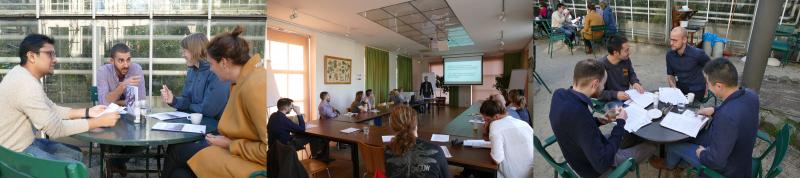
Under the guidance of experts Leslie Mabon (Robert Gordon University), Kelvin Boot (Plymouth Marine lab) and Marie Saville (Minerva Communications), participants were guided through a series of interactive group exercises and discussion sessions designed to demonstrate best practice in working with journalists, and how to make effective use of social media to promote their research and broaden their professional networks. Simulated media interviews revealed the additional challenges of being on the spot in front of a camera lens, emphasising the importance of being prepared and well-practice!
A different form of best practice was explored in the final session of this year's workshop, where the Bowtie risk analysis methodology was explained and demonstrated by Shell's Marcella Dean. Working in small groups and using real data from Shell's onshore Quest project, participants undertook their own risk analysis of the CCS project, including identifying threats, devising safeguards, monitoring protocols and mitigation measures. Simple in theory, but a lot harder in practice!
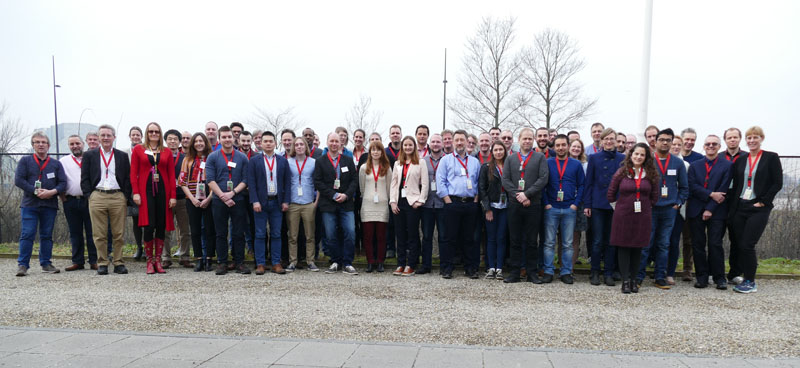
Following the training event, more than 50 researchers from across the STEMM-CCS consortium convened at the Shell Technology Centre, Amsterdam, a short (and very efficient) ferry crossing from central Amsterdam, for the third annual meeting. Members of the Stakeholder Advisory Board, Katherine Romanak (University of Texas at Austin), Mark Chapman (University of Edinburgh) and Tim Dixon (IEAGHG) were once again able to join us for the meeting and provide their insights and feedback on the project.
As well as the opportunity for everyone to share and discuss their work from the previous year, the meeting was also an important checkpoint as we go into the final and very busy year of the project. The main release experiment was obviously a focus of discussions as were the plans for outreach and stakeholder engagement.
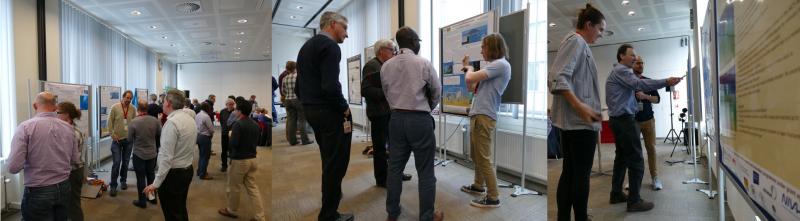
A poster session was held on the second day of the meeting, Shell employees working in CCS related areas were invited to the session and could be seen in detailed discussions with the young researchers. The Stakeholder Advisory Board members judged the posters and awarded ‘Best Poster’ accolades to Elke Kossel and Bettina Schramm (both from GEOMAR) for their posters. Among the criteria used to judge the posters, the collaborative nature of the research presented was considered.
- Log in to post comments